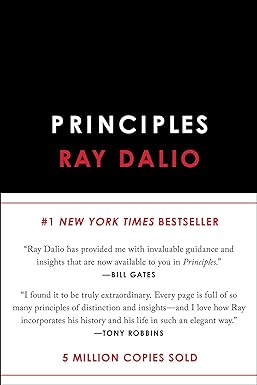
Principles: Life and Work by Ray Dalio Review
4.6 / 5
Overall Rating
Principles: Life and Work
Ray Dalio's Principles is either the most-recommended business book of the decade or 600 pages of self-aggrandizement. Here's where the truth lands.
- Easy-to-read text
- Works well as a gift option
- A solid pick for your shelf
We may earn a commission if you make a purchase through our links.
Pros
- Easy-to-read text
- Works well as a gift option
- A solid pick for your shelf
Cons
- Listing offers limited detail on contents
TL;DR
Ray Dalio's Principles: Life and Work is the management bible most-cited in tech and finance leadership circles, and at 19,000+ ratings it clearly resonates. The first half is autobiographical — how Dalio built Bridgewater Associates into the world's largest hedge fund. The second half is the actual principles: 200+ rules for decision-making, organizational design, and "radical transparency." Worth reading, with one caveat: Dalio's principles work brilliantly inside Bridgewater. Whether they translate elsewhere is the open question.
Why It Matters
Dalio's Principles rewrote the playbook for systematic decision-making in companies that pride themselves on data over hierarchy. Reed Hastings cites it. Marc Andreessen cites it. The book became foundational reading at Stripe, Coinbase, and Bridgewater itself. Whether you implement his "believability-weighted decision-making" framework or not, you'll work with people who have.
Key Specs
- Author: Ray Dalio
- Publisher: Simon & Schuster
- Pages: ~600
- Genre: business, management, autobiography
- First published: 2017
- Format: hardcover, paperback, Kindle, audiobook
- Audiobook narrator: Ray Dalio (own voice) and Jeremy Bobb
- Sequel: Principles for Dealing with the Changing World Order (2021)
Pros
- 200+ explicit principles you can adopt or argue with
- First-half autobiography is genuinely interesting on Bridgewater's history
- Believability-weighted decision-making framework is novel
- Free supplemental materials at principles.com
- Influential enough that working in tech/finance, you'll meet the framework anyway
Cons
- 600 pages is a lot — ~30% could be cut
- "Radical transparency" works at Bridgewater because Bridgewater hires for it; transplanting elsewhere is harder than the book admits
- Some principles are obvious-when-stated ("face reality")
- Dalio's tone occasionally veers into self-aggrandizement
- Practical implementation requires more context than the book provides
Who It's For
Founders, executives, and senior managers in data-driven organizations. People interviewing at Bridgewater, Stripe, or other principles-influenced cultures. Anyone who works in tech leadership and wants the cultural references. Skip it if you're an individual contributor not in management, if you've already absorbed the principles via blog summaries, or if you only read concise business books.
How to Use It
Read the first 200 pages (autobiography) in normal flow. Then read principles selectively — by category — rather than cover-to-cover. Re-read the principles you find most relevant after 3-6 months of attempting to apply them. The audiobook is best for the autobiography section; physical or Kindle is better for the principles index format.
How It Compares
Vs. Good to Great (Jim Collins): Collins is more rigorous research, less personal narrative. Vs. Built to Last (Collins): more historical case-study oriented. Vs. The Hard Thing About Hard Things (Ben Horowitz): Horowitz is more tactical, less framework-driven. Vs. Antifragile (Taleb): Taleb is theoretical philosophy; Dalio is operational principles.
Bottom Line
The right read for tech and finance managers ready to commit 600 pages. Buy it for the framework + autobiography combo. Skip it if you're an individual contributor or if you've already absorbed the principles via secondary sources.
Free Download
The Audible Credit Strategy Guide: Never Waste a Credit Again
Average reader saves $180/year
Instant download. No spam. Unsubscribe anytime.
Affiliate Disclosure
Discussion
Sign in with GitHub to leave a comment. Your replies are stored on this site's public discussion board.